
What 2025 Taught Us: 3 Lessons Growing Vori from to MVP to National Scale

January 1, 2026
·
5
min read
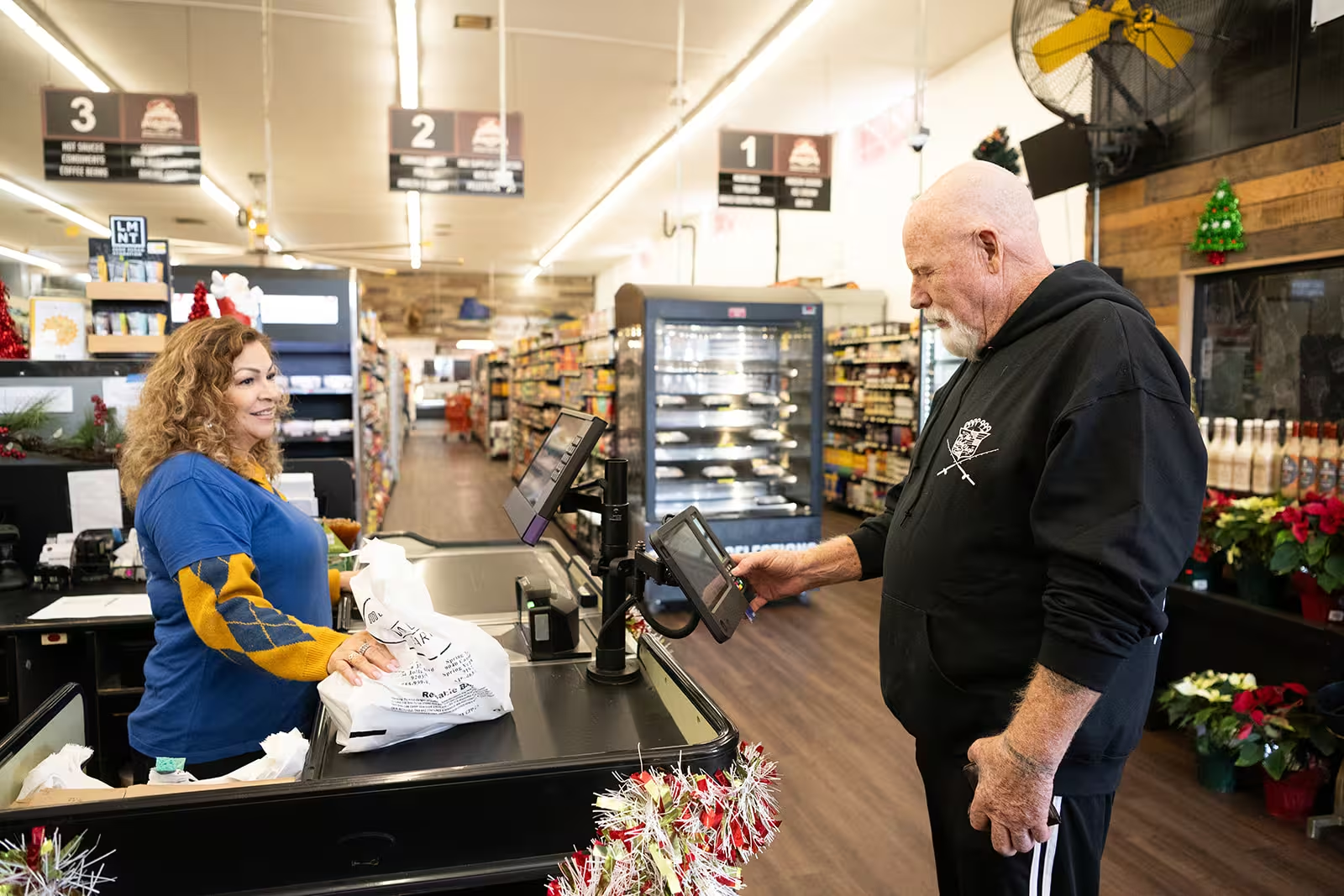
At Vori, we build for grocers who never stop moving.
That belief shaped everything we did in 2025 — how we built product, how we showed up for customers, how we hired, and how we earned the right to scale. Looking back, 2025 wasn’t just a year of growth. It was a year of hard lessons that made the company fundamentally stronger.
We wanted to share the three lessons that mattered most — and the results those lessons helped unlock — as we head into what’s shaping up to be an even bigger 2026.
Lesson #1: Every Customer Is a Showroom — Act Like It
One of the earliest mindset shifts we made as a company was realizing there’s no such thing as a “small” customer.
Every store running Vori is a live demo we don’t control. Investors quietly visit neighborhood markets. Larger chain operators would send their staff to smaller stores nearby to see how our POS performs in the real world. Cashiers, receivers, and department managers form opinions before anyone ever talks to sales. Every customer in essence became a showroom for our product’s performance.
That changed how we thought about product quality and onboarding. MVP wasn’t enough. We needed a minimum awesome product. Vori’s onboarding process wasn’t a checklist — it’s a first-class citizen of our product. If we wouldn’t proudly show a customer to our board, we weren’t ready to scale.
That standard forced us to slow down in the right places and raise the bar everywhere else.
In 2025, grocers validated that Vori was ready to be seen — and relied on — at full scale:
- Grocers processed $355M+ in annualized payments, trusting Vori to run checkout day in and day out.
- Vori helped generate $22M+ in added net sales, proving the platform drove real business outcomes, not just transactions.
- Loyalty-powered stores saw +45.5% more visits and +12.75% higher baskets, showing customers responded to better in-store experiences.
- Across the platform, grocers sold 1.26M pounds of bananas, plus 768k avocados, 765k gallons of milk, and 458k cartons of eggs — everyday volume that only runs on systems you trust.
Those outcomes didn’t come from flashy demos. They came from stores trusting Vori enough to run their business on it, day in and day out.
Lesson #2: Don’t Mess With the Dairy Order
In grocery, reliability is the product.
It doesn’t matter how smart your AI is or how modern your UI looks if the system isn’t rock-solid when it matters. When software touches core workflows — pricing, ordering, checkout — one failure can erase weeks of trust.
We learned this the hard way and invested accordingly. A few years ago, a bug in Vori’s ordering app caused us to fumble a 1,000-gallon milk order for Mollie Stone’s in Palo Alto. At 6am, the store manager called to say their Clover Sonoma delivery wasn’t coming—an existential problem for a grocery store—so we rented a truck, bought the milk ourselves, and delivered it by hand with a handwritten apology. Michael Seibel from Y Combinator often says a startup’s real advantage is superhuman customer service—that day made it real for us.

So in 2025, we put massive investment behind infrastructure, established our official SRE team, and operational rigor. Just as importantly, we invested in support and ops teams that show up like true partners, not ticket queues.
We invested heavily in reliability — and grocers felt the difference:
- Grocers placed 40K+ orders across 3,647 vendors, relying on Vori to support complex, high-frequency ordering without breaking.
- Vori automatically detected 577K+ supplier cost changes, protecting margins without requiring grocers to manually audit invoices.
- Margin protection moved from a constant manual task to a system that works quietly in the background every day — helping grocers like Valley Farm Market save 20+ labor hours per week across pricing and ordering workflows.
That’s what “don’t mess with the dairy order” really means: the basics have to work every single time. Fancy technology only matters if trust is never broken.
Lesson #3: Earn the Right to Scale the Team
One of the hardest lessons — and the one that took the most discipline — was around hiring.
We took nine months to hire our Head of Sales. It felt slow. It was uncomfortable. And it was absolutely the right call.
We stayed founder-led longer than most companies would. Founders sold the first 20 stores, managed to 100, and only then built a go-to-market team to scale toward 1,000+. That forced us to deeply understand our customers, our sales motion, and our real edge before hiring at speed.
Talent density beats headcount. Every time.
In 2025, that discipline paid off:
- We grew to 50+ people while staying founder-led longer than was comfortable, hiring deliberately and only when the role clearly improved customer outcomes.
- We tripled the size of our sales team while maintaining an elite bar for quality.
- We expanded nationwide, launching in 55+ new cities, while continuing to support grocers from Seattle to Staten Island, Oregon to Ohio.

By earning the right to scale, we avoided scaling confusion — and built a team that could carry the culture and the standard forward.
Why It Matters
All three lessons point to the same truth: grocery never stops, and neither can the systems behind it.
In 2025, Vori supported independent grocers nationwide, with some growing from a single store into multiple locations. Behind every metric is a grocer trusting us to protect margins, save time, and help their teams move faster.
As one customer put it:
Best decision I’ve made in the last 20 yearsNick SharmaOwner, The Willows Market in Menlo Park, California
That trust isn’t something we take lightly. Grocery is in our DNA — more than 120 years of experience, shared with every store we work with.
Looking Ahead: 2026 Is Where Momentum Compounds
2025 proved the foundation.
2026 is about escape velocity. And we’re staying focused on the same fundamentals that got us here.
Our ambition is clear: $2B+ in payments processed, powered by a grocery operating system that delivers bigger baskets, stronger margins, and real operational leverage for independent grocers across the country.
We’re building AI-powered infrastructure for the most important consumer category on the planet — not for hype, but to unlock scale, efficiency, and confidence for grocers doing more with less.
For the grocers who never stop moving, we’re building the future of grocery together.
Built for Grocers Who Play to Win.
And we’re just getting started.
— Brandon, Tre, and Rob
Founders, Vori
You may also like
Exclusive: AI grocery startup Vori raises $22 million to help independent retailers compete with Walmart and Amazon
Fortune covers Vori's $22M Series B to bring AI to independent grocers fighting Walmart and Amazon.
Exclusive: AI grocery startup Vori raises $22 million to help independent retailers compete with Walmart and Amazon
Fortune covers Vori's $22M Series B to bring AI to independent grocers fighting Walmart and Amazon.
In the News

Series B Memo: Building the Operating System for How America Feeds Itself
Grocery still runs on Reagan-era tech. CEO Brandon Hill's Series B memo on raising $22M to put an AI-native operating system in independent stores.
Series B Memo: Building the Operating System for How America Feeds Itself
Grocery still runs on Reagan-era tech. CEO Brandon Hill's Series B memo on raising $22M to put an AI-native operating system in independent stores.
Funding News
Vori Raises $22M to Build the Operating System for the World’s Grocery Stores
AI built for the aisles: Vori autonomously manages operations for a $1.5 trillion industry still running on technology from the Reagan administration
Vori Raises $22M to Build the Operating System for the World’s Grocery Stores
AI built for the aisles: Vori autonomously manages operations for a $1.5 trillion industry still running on technology from the Reagan administration
Press Release