
AI in grocery: 70% are planning for it, 13% are using it

Jesse Lopez
Head of Marketing
·
October 20, 2026
·
5
min read

In June we published The 2026 Independent Grocery Operator Study, conducted by EnsembleIQ in partnership with Progressive Grocer. We surveyed 53 independent grocery operators across the country: owners, general managers, and store managers with direct involvement in technology decisions.
One finding stood out from everything else we asked about. Independent grocers are not skeptical about AI. They’re stuck.
Seventy percent are either planning to adopt AI tools or actively exploring them. Thirteen percent are using AI in a meaningful way today. That gap isn’t a story about hesitation. It’s a story about a segment that knows what it wants and can’t find a version of it built for how grocery actually works.
Here’s what the data showed.
Operators want AI most for promotions, reporting, and pricing
We asked operators which areas of their store would benefit most from AI and automation tools, and let them select everything that applied. Five areas pulled away from the rest.
None of these are speculative. Nobody asked for AI that writes marketing copy or predicts consumer trends three years out. They asked for help with the work already on their desk.
Labor management is the least automated job, and the least satisfying
The survey tracked both automation levels and satisfaction across eleven operational functions, from POS to loyalty to vendor ordering.
The pattern held in every single one. Higher automation came with higher satisfaction. Not usually. Every function, no exceptions.
The inverse is where it gets uncomfortable. The two least automated functions are labor management, at 13% mostly or fully automated, and vendor ordering, at 34%. Those same two report the lowest satisfaction scores in the entire study: 29% and 39%.
Manual work isn’t just slow. It’s the part of the job people have come to resent.
A third of operators spend 11+ hours a week on inventory alone
The hours bear that out. Among the operators surveyed:
- 29% spend eleven or more hours a week on inventory management
- 28% spend eleven or more hours a week on receiving and invoice management
- 27% spend that much on pricing, and another 27% on labor management
Vendor ordering, still done largely from memory and clipboards at most stores, ranks among both the most time-consuming and the least satisfying processes in the building.
None of this shows up cleanly on a P&L. An operations director spending three hours building a produce order from memory on a Sunday afternoon isn’t a line item anywhere. But those hours cost something real in labor, in accuracy, and in what doesn’t get done while someone is doing paperwork.
The hesitation is rational, and so is the cost of waiting
It would be easy to read 13% as a segment being slow. That’s not what’s happening.
New tools carry implementation risk, training burden, and cost. Independent grocery runs on one to three percent margins, which leaves very little room for a system that doesn’t work. Operators who have been sold an expensive promise before are right to be careful about the next one.
But the survey makes the cost of staying manual just as visible. A third of operators told us their POS is only somewhat integrated or not well integrated with their other tools. Another third said they don’t use back-office software at all.
That fragmentation has a specific consequence. A good decision made in one system doesn’t reach the rest of the business. A price change approved somewhere doesn’t update the shelf tag. A cost increase caught on an invoice doesn’t trigger a pricing review. Every gap in the stack is a gap in visibility, and visibility is what separates the stores managing margin proactively from the stores finding out after the fact.
Forty-nine percent of operators said they have no reliable system to catch vendor cost changes when they happen. Fifty-five percent named price change management as a capability they need to improve. These aren’t operators who don’t care about margin. When the system doesn’t surface the information fast enough, caring doesn’t close the gap.

"I am told the error rate with vendors is at an all time high, and the time it takes to check in vendors and catch costing errors takes retailers away from their other day to day duties."
The stores already using AI are compounding an advantage
The 13% actively using AI or automation tools are building operational advantages that stack: better demand forecasting, smarter pricing decisions, less time spent on tasks that don’t require a person.
That’s the part worth paying attention to. In a segment running on thin margins, an operator who gets four hours back every week and catches cost increases the day they arrive isn’t slightly ahead. They’re compounding.
"This technology has the potential to unlock unprecedented efficiency and abundance for independents across the industry."
What this means if you run a grocery store
Three things follow from the data, whatever software you run.
Start where the hours are, not where the hype is
The functions operators named as their biggest AI opportunities are the same functions eating the most time in the building. Promotion management and reporting both came in at 68%, pricing at 64%, and inventory at 60%. Those aren’t aspirational picks. They’re the jobs people are already doing by hand, every week, and would rather not be.
That gives you a filter. If a tool doesn’t touch one of those four, it isn’t solving your problem this year, no matter how impressive the demo is. Plenty of AI being sold into retail right now is aimed at functions that barely register for an independent store: customer sentiment analysis, assortment modeling, long-range demand forecasting. Interesting work, wrong order of operations.
Pick the function where someone on your team is currently spending eleven hours a week, and start there.
Treat integration as the prerequisite, not a nice-to-have
A third of operators told us their POS is only somewhat integrated or not well integrated with their other tools. Another third said they don’t use back-office software at all. That fragmentation is the single biggest obstacle to AI being useful in an independent store, and it has nothing to do with the AI itself.
Here’s why it matters in practice. An AI tool reading from a system that’s disconnected from your POS will produce a number that doesn’t match the number in your reports. The first time that happens, you’ll check. The second time, you’ll stop trusting the tool. By the third time, nobody on your team opens it.
Accuracy isn’t a feature a vendor can promise you. It’s a function of whether the tool is reading the same data your reports run on. Ask that question before you ask anything else, because an AI layered on top of a disconnected stack inherits every disagreement already in it.
Judge it on whether it saved someone an hour
The clearest pattern in the entire study is that automation and satisfaction move together. Across all eleven functions we measured, the more automated a function was, the more satisfied operators were with how it ran. Every function, no exceptions.
That gives you a simpler evaluation test than most vendor conversations will offer. Not whether the output is impressive. Not whether it uses the newest model. Just: after thirty days, is someone on your team spending less time on this than they were before?
If the answer is no, the tool isn’t working, whatever else it’s doing well. And if the answer is yes, the hours it gave back are real money in a business running on one to three percent margins, which is why the stores already using these tools are pulling ahead of the ones still evaluating.
We built Chip for exactly this work
Grocers who join Vori arrive facing the same set of problems. Promotions take too long to build. Cost increases get caught after the fact, if at all. A pricing question means pulling a report, and the answer arrives after the decision had to be made.
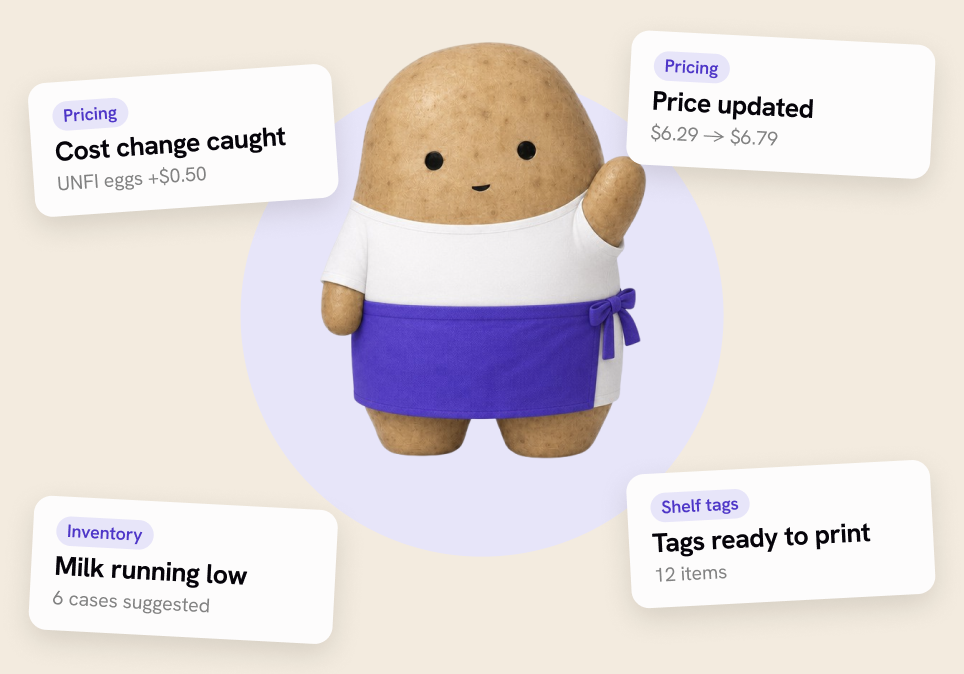
So we built Chip, a virtual employee powered by AI and built for grocery, that handles promotions, performance questions, shelf tags, food service menus, store setup, and more. Chip reads the same data your reports run on, because Vori already runs checkout, pricing, ordering, receiving, inventory, loyalty, and reporting for the store. There’s no second system to reconcile and no separate database to trust.
That’s our answer to the problem this data describes. There will be others, and the three criteria above apply to all of them, including ours.
About the study.
The 2026 Independent Grocery Operator Study was commissioned by Vori and conducted by EnsembleIQ in partnership with Progressive Grocer in June 2026, surveying 53 independent grocery operators with direct involvement in technology decisions. Read the full report.
About Vori.
Vori is the modern grocery operating system built exclusively for independent grocers, bringing checkout, pricing, ordering, receiving, inventory, loyalty, and reporting into one connected system that protects margin and grows sales every day.
You may also like
AI in grocery: 70% are planning for it, 13% are using it
What 53 independent grocery operators told us about where AI should help, what's holding them back, and what the early adopters gained.
AI in grocery: 70% are planning for it, 13% are using it
What 53 independent grocery operators told us about where AI should help, what's holding them back, and what the early adopters gained.
Benchmark Report
Introducing Chip: the virtual employee built for independent grocers
Every Vori store now has a virtual employee. Chip plans promotions, catches cost changes, designs tags, and sets up your store.
Introducing Chip: the virtual employee built for independent grocers
Every Vori store now has a virtual employee. Chip plans promotions, catches cost changes, designs tags, and sets up your store.
Product Update