
POS, Pricing, Inventory, Loyalty: Why Your Grocery Tools Need to Share the Same Data

Jesse Lopez
Head of Marketing
·
July 10, 2026
·
8
min read
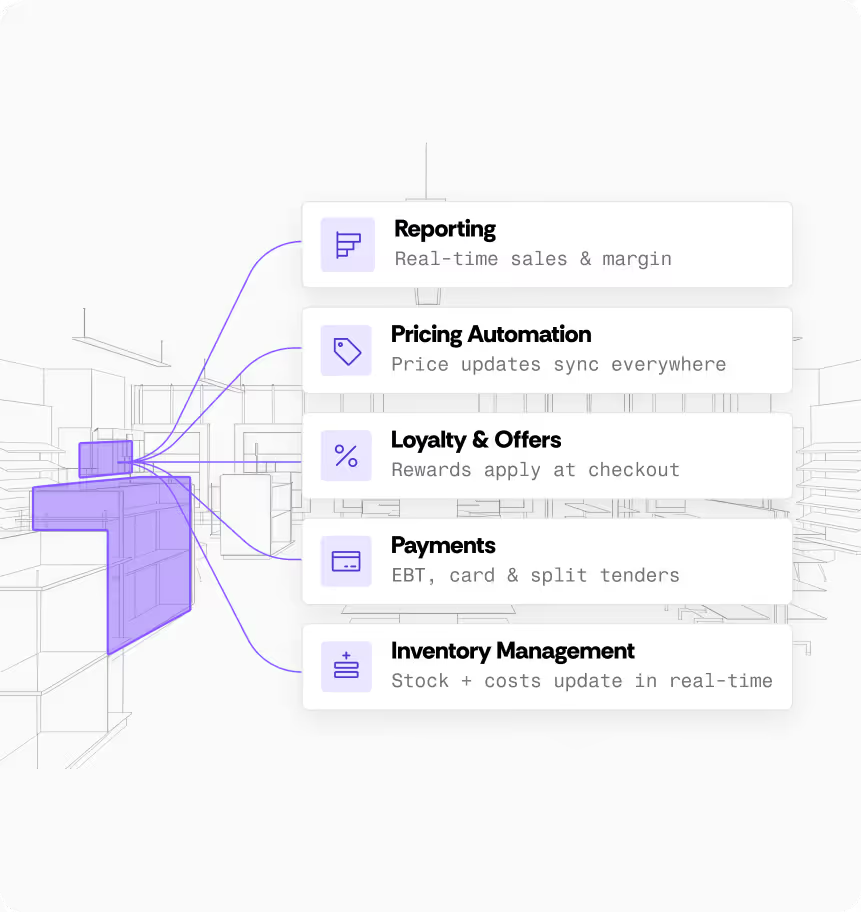
Most independent grocery stores do not lack technology. They lack technology that talks to itself. You may run a separate POS, a separate pricing tool, a separate loyalty program, and a separate ordering system. Each one collects useful data. But when those systems do not share that data, your grocery store management software gives you an incomplete picture, and you make decisions with pieces missing. This piece covers four failure modes that come from disconnected tools, what each one costs you in margin or sales, and what your store looks like when all four systems share the same data.
What Disconnected Tools Actually Cost Independent Stores
The cost of running disconnected grocery systems does not show up as a single line item. It shows up as small losses across every function. Inventory records drift out of sync and drive the wrong orders. Pricing updates reach the register days after the cost changed. Loyalty offers go out to every shopper, whether or not the offer fits what they buy. None of these is dramatic on its own. Together, they add up.
The research backs this up. ECR Community, a European retail industry research organization, has found that roughly 60% of SKU-level inventory records are inaccurate at any given time. That inaccuracy is a documented source of cost and service problems in retail: wrong replenishment, stockouts, overstock, and poor on-shelf availability. Now put that next to the margin math. FMS Solutions, a food retail financial benchmarking firm, and the National Grocers Association report independent grocers operating at 1.9% net profit, with total expenses consuming 25.8% of sales. At that margin, small and constant losses from disconnected systems compound quickly into the difference between a profitable year and a break-even one.
How Pricing That Doesn't Sync to the Register Quietly Destroys Margin
When pricing lives in a system separate from your POS, every vendor cost increase opens a window of loss. The invoice arrives, the cost goes up, and the register keeps charging the old price until someone catches it and changes it by hand. At 1.9% net profit, that window is expensive. FMS Solutions and the National Grocers Association put average gross margins at 27.4% of sales, which leaves almost no cushion between what your vendors charge and what your shoppers pay.
Your data says the same thing. In the 2026 Independent Grocery Operator Study, margin management and price change management were the two operational capabilities independent grocers most often named as areas they need to improve to compete with big-box grocery. Cost change detection was close behind. These are not abstract worries. They are the daily reality of running a store where costs move faster than tags do.
Progressive Grocer, the trade magazine for the grocery industry, identifies vendor cost change monitoring at invoice receipt as the highest-impact task for independent stores to digitize. The reason is simple: a system that flags cost changes as invoices arrive lets you fix margin leaks before they compound. A disconnected pricing system does the opposite. Every increase has to be spotted by hand, entered by hand, and pushed to the register by hand. In a store taking invoices from dozens of vendors a week, that means several items are mispriced at any given moment, and you are losing a little on each one.
What Happens When Inventory Data Doesn't Feed Replenishment Decisions
When your inventory counts and your ordering live in separate systems, you get both failure modes at once. You get stockouts, because the system thinks product is on the shelf when it is not. And you get overstock, because it does not see how much you already have. A 2025 peer-reviewed study on measuring inventory record inaccuracy makes the mechanism plain: inaccurate records cause lost sales from stockouts, extra holding costs from overstock, and poor service levels all together. Replenishment logic assumes the record is right. When the record is wrong, the orders are wrong in a way you cannot see until the shelf tells you.
Your own numbers point to the same pressure. In the 2026 Independent Grocery Operator Study, inventory management was the single most time-consuming task in the store, with 29% of independent grocers spending eleven or more hours a week on it. It was also the number one area where grocers said they need more technology. Time that heavy usually means the work is being stitched together across tools that do not connect.
The upside of connecting the two is measurable. ECR Community research shows that correcting inventory records and feeding them into replenishment decisions produces sales lifts of 4% to 8% through better on-shelf availability. Read that as revenue you already earned and lost: 4% to 8% more sales, from having product on the shelf when a shopper reaches for it.
Why Loyalty Without Purchase Data Produces Offers That Don't Move Shoppers
A loyalty program disconnected from your POS can enroll shoppers and hand out points. What it cannot do is see what any individual shopper actually buys. So every offer it sends is a guess. Send a produce promotion to a shopper who never buys produce and you have not delivered value. You have delivered noise.
The gap is visible in your own data. In the 2026 Independent Grocery Operator Study, 68% of independent grocers run a loyalty program, but ease of integration with the POS was the lowest-rated part of those programs, with just 56% agreeing it was easy. Only 66% felt they were using their loyalty data effectively to grow the business. And the personalization tells the story: only 42% of these programs send discounts based on what a shopper actually bought, and just 17% offer personalized product recommendations. Most loyalty programs are collecting data they never turn back into a relevant offer.
Shoppers notice. FMI, the Food Marketing Institute, and NielsenIQ, the consumer intelligence company, report that more than 90% of shoppers now buy groceries both in-store and online, and that retailers who use purchase data to send relevant, personalized offers earn higher spend and stronger loyalty. FMI's 2026 U.S. Grocery Shopper Trends research names perceived value and a personalized experience as primary drivers of which store a shopper returns to. Statista, a market data and research platform, finds supermarkets have the highest loyalty participation of any retail category, which means this is exactly the channel where shoppers expect data-driven value, and exactly where a disconnected program falls short.
What the Store Looks Like When All Four Functions Share the Same Data
When POS, pricing, inventory, and loyalty run on the same data, each failure mode above disappears. A vendor cost increase gets caught the moment the invoice is reviewed, flows into a suggested retail price that keeps your target margin, and syncs to checkout and shelf tags once you approve it. Inventory updates continuously as items sell and deliveries arrive, so your orders draw from what the store actually moved instead of what you remember. Loyalty offers reach shoppers based on what they bought at the register, not what a default template picked. The 2026 Independent Grocery Operator Study found that higher automation tracks with higher satisfaction across every function, which is what you would expect when the systems finally line up.
The proof shows up in real stores. The Market at Edgewood took over a store that was losing money, moved off a disconnected legacy system, and used Vori's cost-change and pricing tools to lift gross margins by 7%. That is the pricing failure mode solved: when cost changes flow to the register without delay, margin is protected instead of quietly lost. At Talin Market in Albuquerque, weekly ordering time dropped 67% once ordering drew from real sales data, and a single price change went from five or six minutes to seconds. That is the inventory and pricing work that used to eat the day, done in a fraction of the time. The Willows Market lifted total net sales 9.7% after bringing checkout, pricing, and loyalty into one connected system.
The individual tools are not the differentiator. Plenty of stores own a POS, a pricing tool, an ordering app, and a loyalty program. The connections between them are what protect margin, keep shelves right, and turn checkout data into offers that bring shoppers back. That is what a connected grocery system does, and it is the whole argument for making your tools share one source of truth.
See how Vori connects POS, pricing, inventory, and loyalty on one system. Book a demo and protect the margin your current tools are letting slip.
FAQs
Everything you need to know about Vori. Can’t find the answer you’re looking for? Please chat to our friendly team.
You may also like
POS, Pricing, Inventory, Loyalty: Why Your Grocery Tools Need to Share the Same Data
Learn why the problem isn't your grocery tools but the gaps between them. When POS, pricing, inventory, and loyalty don't share data, you lose margin you can't see. Here's what connecting them changes.
POS, Pricing, Inventory, Loyalty: Why Your Grocery Tools Need to Share the Same Data
Learn why the problem isn't your grocery tools but the gaps between them. When POS, pricing, inventory, and loyalty don't share data, you lose margin you can't see. Here's what connecting them changes.
Explained
The Complete Guide to Grocery Store Management Software in 2026 (Features That Actually Matter)
Most grocery store management software is built for general retail, not grocery. Here are the capabilities that actually matter for independent stores, and why they only pay off when they connect.
The Complete Guide to Grocery Store Management Software in 2026 (Features That Actually Matter)
Most grocery store management software is built for general retail, not grocery. Here are the capabilities that actually matter for independent stores, and why they only pay off when they connect.
Buyer's Guide