
The Complete Guide to Grocery Store Management Software in 2026 (Features That Actually Matter)

Jesse Lopez
Head of Marketing
·
July 15, 2026
·
10
min read
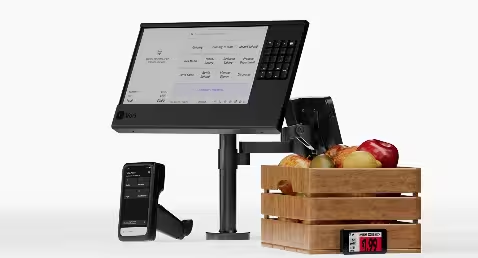
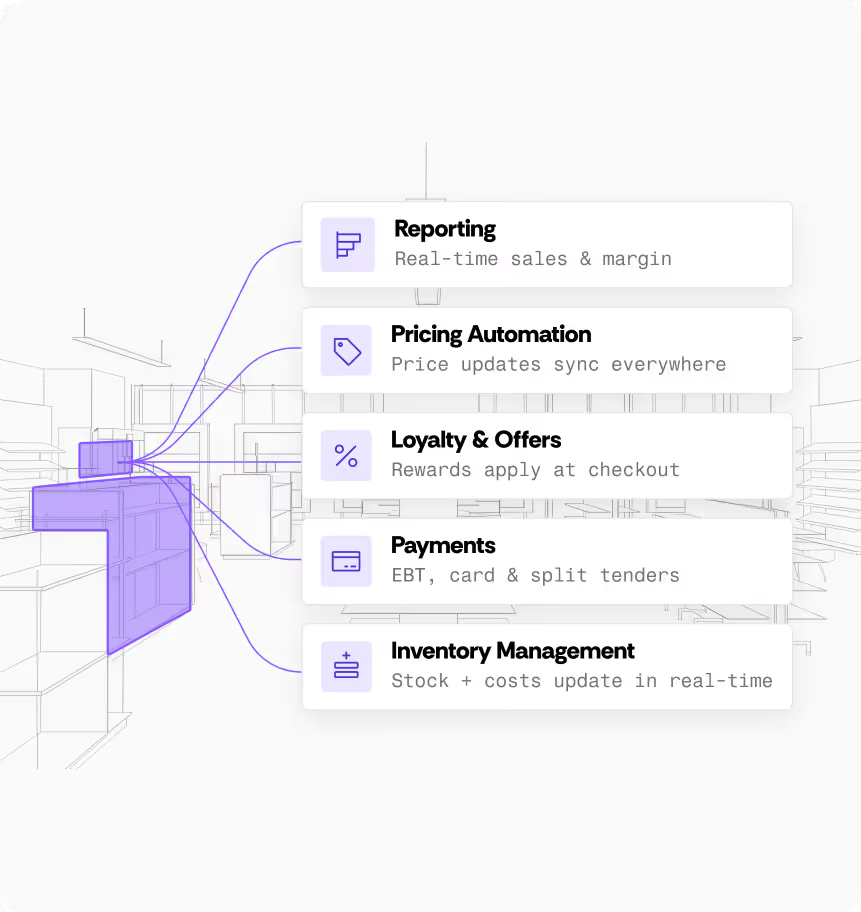
Most grocery store management software fails independent stores. Not because it lacks features, but because it was never built for how grocery runs. A system built for general retail can process a transaction. A system built for grocery handles EBT, variable-weight items, DSD receiving, real-time cost changes, and loyalty at the register at the same time. This guide covers the five capabilities that define a complete grocery management system and what each looks like in Vori.
Independent grocers already feel the pressure this software is meant to answer. Based on the 2026 Independent Grocery Operator Study, commissioned by Vori and conducted by EnsembleIQ Insights & Innovation in partnership with Progressive Grocer, 83% of independent grocers named rising operational costs a top challenge for the year, and 60% named pressure on margins from price competition. Only 15% feel highly successful competing with big-box grocery.
What a Purpose-Built POS Must Handle That Generic Retail Checkout Cannot
Grocery checkout is more complex than general retail, and the gap starts at payment. USDA guidance for new SNAP retailers documents that EBT-capable equipment must separate eligible from ineligible items and keep required records at the register, which most generic retail systems cannot do. The Nutrition Incentive Hub, in a USDA-funded guide to grocery POS, calls scale and scanner integration standard infrastructure for variable-weight produce, meat, and deli. Without it, cashiers key weights by hand, which creates errors and slows the lane. eWIC adds one more layer: the POS has to validate every item against a state approved list in real time before the sale completes.
Vori's POS handles every tender type in one uninterrupted flow. EBT, eWIC, credit, debit, cash, house accounts, and gift cards run through the same lane, with no separate terminal. Variable-weight items ring through with integrated scales and fast PLU lookup. Vori keeps running offline, so checkout continues during an outage, and new cashiers are operational in under two hours. The study shows the gap: one in three independent grocers said their POS is only somewhat or not well integrated with their other tools.
How Pricing Automation Catches Cost Changes Before They Reach the Lane
Independent grocery runs on thin margins, which is exactly why pricing discipline matters most. Benchmarking from FMS Solutions, a food retail financial benchmarking firm, and the National Grocers Association puts average net profit near 1.9% of sales, with gross margins around 27.4%. In that range, a few missed cost increases on high-volume items erase the profit on them. Progressive Grocer, the trade magazine for the grocery industry, ranks monitoring vendor cost changes at invoice receipt as the highest-impact task independents can digitize, because catching the change early is what lets you act before margin slips. The same benchmarking ties pricing discipline to the stores that pull ahead, with profit leaders averaging closer to 7.9% net profit.
Grocers know this is where the fight is. In the 2026 Independent Grocery Operator Study, margin management was the single most-cited capability independent grocers said they need to compete with big-box stores, chosen by 64%, and it topped the list of urgent priorities at 43%.

"If the price goes up or down, Vori tells me, 'You're losing on that, you need to change the price,' based on my margin target."
Vori Pricing Automation reads every vendor invoice, flags cost changes the moment they arrive, and shows the margin impact before you approve anything. You see your current margin, a suggested retail price that holds your target, and low, medium, and high options beside it. Once approved, the price syncs to checkout, electronic shelf labels, and reporting with no separate publishing step. After activating Vori's pricing tools, The Market at Edgewood improved gross margins 7% within five months. For more on how cost-change detection protects margin, see our companion piece on reading invoices like a pro.
Why Inventory and Ordering Must Connect to What the Store Actually Sells
Inventory records drift, and the drift costs sales. Research from ECR Community, a European retail industry research organization, finds that roughly 60% of SKU-level inventory records are inaccurate at any given moment, and that fixing them to an accurate perpetual count lifts sales 4% to 8%, because product is more reliably on the shelf. Independents carry a harder version of this. The USDA Economic Research Service and the Agricultural Marketing Resource Center, a USDA-funded resource for food and agricultural businesses, both note that independents order across a primary wholesaler plus regional distributors, local producers, and DSD vendors, each with its own cycle and pricing. Ordering that from memory produces stockouts on fast movers and overstock on slow ones. The cost shows up in shrink, which FMS and NGA data put at 3.5% in 2024.
This is the gap grocers feel most. In the operator study, inventory management was the number-one area independent grocers said they need more technology, and the most time-consuming task in the store, with 29% spending 11 or more hours on it every week. Vendor ordering scored the lowest automation of any back-office function, and the lowest satisfaction to match.
"Consolidation of movement data used to take me 2 to 3 hours to do... now it can be done in less than an hour."
Vori connects register movement straight to the ordering workflow, so your team sees 7-day, 30-day, and last-order sales while building each vendor order. PAR-level replenishment builds orders from sales velocity and on-hand counts, not gut feel. Receiving updates inventory in real time, flags cost changes and new items at the dock, and sends orders by EDI, CSV, or email to match how each vendor already works. Talin Market cut weekly ordering time by 67% after activating Vori. For more on accurate counts, see Grocery Inventory Management 101.
How Loyalty and Shopper Engagement Built Into Checkout Changes Behavior
Shoppers spread their trips across many stores now, so recognition and relevance are what bring them back. Research from FMI, the Food Marketing Institute, the food retail trade association, with NielsenIQ, the consumer intelligence company, finds that more than 90% of shoppers use both in-store and online grocery, which makes switching the default when a store does not deliver value. FMI's U.S. Grocery Shopper Trends 2026 shows that digitally engaged shoppers spend more and stay more loyal with retailers who use purchase history to send relevant offers.
Independent grocers already see this as their edge. In the operator study, targeted shopper messaging was the top operational capability independent grocers named for competing with big-box stores, chosen by 75%, and more than two-thirds already run a loyalty program.
"SMS marketing is going crazy. We are seeing people flock to the store 30 minutes after sending the message."
Vori's shopper engagement runs loyalty enrollment, SMS marketing, and targeted promotions inside the POS, so it all runs at checkout without interrupting the lane. Shoppers join by entering a phone number on the customer display in seconds. Vori targets offers by how each shopper actually buys, so a produce regular who never visits the meat case gets an offer built to expand their basket, and rewards apply automatically. Because the offer is tied to real purchase history instead of a blanket discount, Vori stores see higher visit frequency and larger baskets on average.
What Reporting Looks Like When Every Function Connects Into One View
The stores that lead on profit are the ones watching the right numbers and acting fast. FMS and NGA benchmarking ties top performance to grocers who track gross margin by department and adjust in time. FMI's State of Technology reporting notes that real-time dashboards and AI-driven insights are moving from enterprise chains into everyday grocery tools through 2026, and Grocery Dive, a grocery industry trade publication, reported from the 2026 NGA gathering that independents need to use their data to decide faster and close the gap with chains that staff full analytics teams. Disconnected systems make that impossible: a store running POS, inventory, and ordering in separate tools cannot see how a price change moved margin without assembling the data by hand.
The appetite is there. In the 2026 Independent Grocery Operator Study, reporting was one of the two areas independent grocers said would benefit most from AI and automation, named by 68%. Yet only 13% use AI tools today, while 70% are planning or exploring. The stores that connect their data first will be the ones ready to use it.
"Now I can be in the know at all times. I can look at my phone and see labor, see sales, see what is happening. I do not need to be in the store anymore."
Vori Reporting brings sales, cash, tills, loyalty, and inventory into one view you can open from a phone or desktop in real time. You see margin by department, labor as a percentage of sales, and loyalty enrollment without pulling from separate systems. Because every function already runs on Vori, the numbers reflect what happened, not what someone typed into a spreadsheet after the fact.
How Vori Connects All Five Capabilities in One Connected Platform
A grocery management system only works as a system when the five capabilities connect. Pricing updates from the back office flow to checkout on their own. Inventory updates from receiving feed the next order. Loyalty data from the lane tells you which promotions earn repeat visits. The operator study points at the same conclusion from the other side: higher automation tracked with higher satisfaction across every function grocers rated, and one in three surveyed grocers do not use back-office software at all.
Here is what the connected system replaces. The pricing coordinator hand-keying cost changes. The inventory manager reconciling counts off a spreadsheet. The order clerk rebuilding vendor orders from memory each week. The owner who can only see the store when standing in it. Vori describes its products as virtual employees that never clock out. The routine work runs itself, and your team spends its hours on the store instead of the software. After activating Vori, The Market at Edgewood improved gross margins 7% in five months and Talin Market cut ordering time 67%. Those outcomes are not available from software built for general retail. They come from a system built for how grocery actually works.
FAQs
Everything you need to know about Vori. Can’t find the answer you’re looking for? Please chat to our friendly team.
You may also like
POS, Pricing, Inventory, Loyalty: Why Your Grocery Tools Need to Share the Same Data
Learn why the problem isn't your grocery tools but the gaps between them. When POS, pricing, inventory, and loyalty don't share data, you lose margin you can't see. Here's what connecting them changes.
POS, Pricing, Inventory, Loyalty: Why Your Grocery Tools Need to Share the Same Data
Learn why the problem isn't your grocery tools but the gaps between them. When POS, pricing, inventory, and loyalty don't share data, you lose margin you can't see. Here's what connecting them changes.
Explained
The Complete Guide to Grocery Store Management Software in 2026 (Features That Actually Matter)
Most grocery store management software is built for general retail, not grocery. Here are the capabilities that actually matter for independent stores, and why they only pay off when they connect.
The Complete Guide to Grocery Store Management Software in 2026 (Features That Actually Matter)
Most grocery store management software is built for general retail, not grocery. Here are the capabilities that actually matter for independent stores, and why they only pay off when they connect.
Buyer's Guide